Chapter 20 “Margin of Safety” as the Central Concept of Investment
a stock with a P/E ratio of 11 can be said to have earning power of 9%.
If the purchases are made at the average level of the market over a span of years, the prices paid should carry with them assurance of an adequate margin of safety.
Graham elegantly summarized the discussion that follows in a lecture he gave in 1972: “The margin of safety is the difference between the percentage rate of the earnings on the stock at the price you pay for it and the rate of interest on bonds, and that margin of safety is the difference which would absorb unsatisfactory developments…. the stock was selling at 11 times earnings, giving about 9% return as against 4% on bonds. In that case you had a margin of safety of over 100 percent.
Observation over many years has taught us that the chief losses to investors come from the purchase of low-quality securities at times of favorable business conditions. … Thus it follows that most of the fair-weather investments, acquired at fair-weather prices, are destined to suffer disturbing price declines when the horizon clouds over-and often sooner than that.
To Sum Up
Investment is most intelligent when it is most businesslike.
The first and most obvious of these principles is, “Know what you are doing-know your business.” For the investor this means: Do not try to make “business profits” out of securities-that is, returns in excess of normal interest and dividend income-unless you know as much about security values as you would need to know about the value of merchandise that you proposed to manufacture or deal in.
A second business principle: “Do not let anyone else run your business, unless (1) you can supervise his performance with adequate care and comprehension or (2) you have unusually strong reasons for placing implicit confidence in his integrity and ability.” For the investor this rule should determine the conditions under which he will permit someone else to decide what is done with his money.
A third business principle: “Do not enter upon an operation-that is, manufacturing or trading in an item-unless a reliable calculation shows that it has a fair chance to yield a reasonable profit. In particular, keep away from ventures in which you have little to gain and much to lose.” For the enterprising investor this means that his operations for profit should be based not on optimism but on arithmetic. For every investor it means that when he limits his return to a small figure-he must demand convincing evidence that he is not risking a substantial part of his principal.
A fourth business rule is more positive: “Have the courage of your knowledge and experience. If you have formed a conclusion from the facts and if you know your judgment is sound, act on it-even though others may hesitate or differ.” (You are neither right nor wrong because the crowd disagrees with you. You are right because your data and reasoning are right.) Similarly, in the world of securities, courage becomes the supreme virtue after adequate knowledge and a tested judgment are at hand.
Fortunately for the typical investor, it is by no means necessary for his success that he bring these qualities to bear upon his program-provided he limits his ambition to his capacity and confines his activities within the safe and narrow path of standard, defensive investment. To achieve satisfactory investment results is easier than most people realize; to achieve superior results is harder than it looks.
Commentary on Chapter 20
If we fail to anticipate the unforeseen or expect the unexpected in a universe of infinite possibilities, we may find ourselves at the mercy of anyone or anything that cannot be programmed, categorized, or easily referenced. – Agent Fox Mulder, The X-Files
In 1999, risk didn’t mean losing money; it meant making less money than someone else.
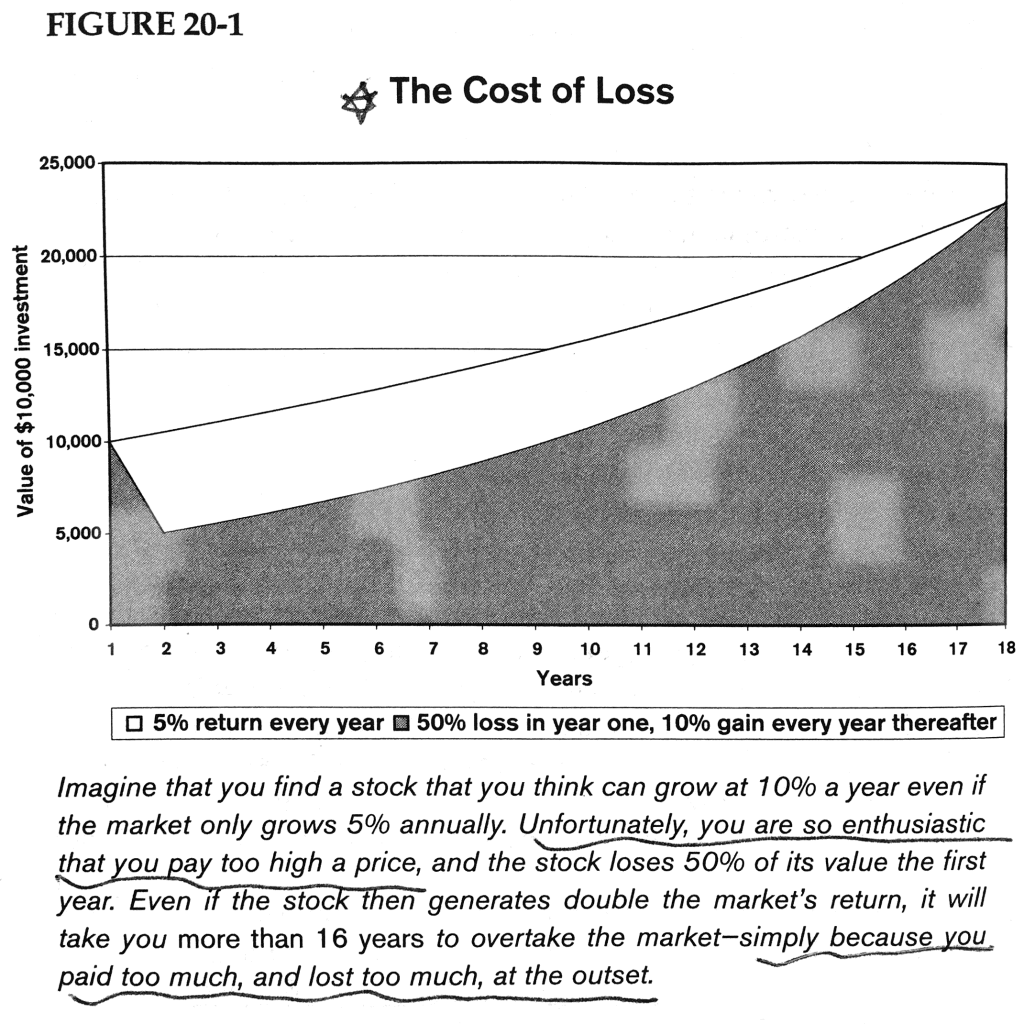
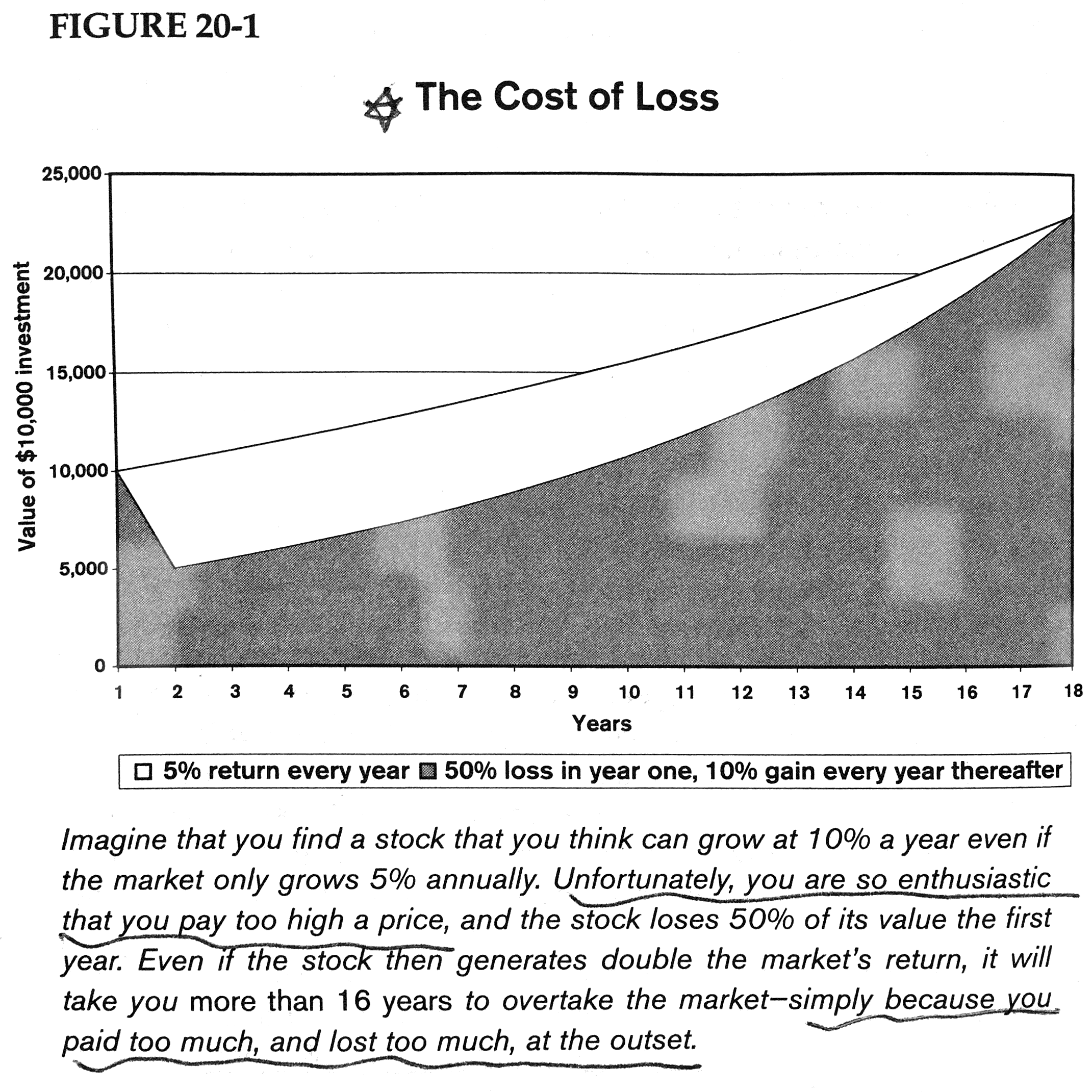
The people who take the biggest gambles and make the biggest gains in a bull market are almost always the ones who get hurt the worst in the bear market that inevitably follows. Being “right” makes speculators even more eager to take extra risk, as their confidence catches fire. And once you lose big money, you then have to gamble even harder just to get back to where you were, like a race-track or casino gambler who desperately doubles up after every bad bet. Unless you are phenomenally lucky, that’s a recipe for disaster. No wonder, when he was asked to sum up everything he had learned in his long career about how to get rich, the legendary financier J. K. Klingenstein of Wertheim & Co. answered simply: “Don’t lose.”
Risk exists in another dimension: inside you. If you overestimate how well you really understand an investment, or overstate your ability to ride out a temporary plunge in prices, it doesn’t matter what you own or how the market does. Ultimately, financial risk resides not in what kinds of investments you have, but in what kind of investor you are. If want to know what risk really is, go to the nearest bathroom and step up the mirror. That’s risk, gazing back at you from the glass.
The Nobel-prize-winning psychologist Daniel Kahneman explains two factors that characterize good decisions:
“well-calibrated confidence” (do I understand this investment as well as I think I do?) [realistically assess the probability of being right]
“correctly-anticipated regret” (how will I react if my analysis turns out to be wrong?) [the consequences of being wrong]
The investment philosopher Peter Bernstein: “In making decision under conditions of uncertainty, the consequences must dominate the probabilities. We never know the future.” Thus, as Graham has reminded you in every chapter of this book, the intelligent investor must focus not just on getting the analysis right. You must also ensure against loss if your analysis turns out to be wrong-as even the best analyses will be at least some of the time.
Simply by keeping your holdings permanently diversified, and refusing to fling money at Mr. Market’s latest, craziest fashions, you can ensure that the consequences of your mistakes will never be catastrophic. No matter what Mr. Market throws at you, you will always be able to say, with a quiet confidence, “This, too, shall pass away.”
Preface to the fourth edition, by Warren E. Buffett.
To invest successfully over a lifetime does not require a stratospheric IQ, unusual business insights, or inside information. What’s needed is a sound intellectual framework for making decisions and the ability to keep emotions from corroding the framework. This book precisely and clearly prescribes the proper framework. You must supply the emotional discipline.
if you pay special attention to the invaluable advice in Chapters 8 and 20 — you will not get a poor result from your investment.
Benjamin Graham 1894-1976
Several years ago Ben Graham, then almost eighty, expressed to a friend the though that he hoped every day to do “something foolish, something creative and something generous.”
The inclusion of that first whimsical goal reflected his knack for packaging ideas in a form that avoided any overtones of sermonizing or self-importance. Although his ideas were powerful, their delivery was unfailingly gentle.
A Note about Benjamin Graham by Jason Zweig.
I was struck by Graham’s certainty that, sooner or later, all bull markets must end badly.
Despite a harrowing loss of nearly 70% during the Great Crash of 1929-1932, Graham survived and thrived in its aftermath, harvesting bargains from the wreckage of the bull market.
Combining his extraordinary intellectual powers with profound common sense and vast experience, Graham developed his core principles, which are at least as valid as they were during his lifetime:
A stock is not just a ticker symbol or an electronic blip; it is an ownership interest in an actual business, with an underlying value that does not depend on its share price.
The market is a pendulum that forever swings between unsustainable optimism (which makes stocks too expensive) and unjustified pessimism (which makes them too cheap). The intelligent investor is a realist who sells to optimists and buys from pessimists.
The future value of every investment is a function of its present price. The higher the price you pay, the lower your return will be.
No matter how careful you are, the one risk no investor can ever eliminate is the risk of being wrong. Only by insisting on what Graham called the “margin of safety” — never overpaying, no matter how exciting an investment seems to be — can you minimize your odds of error.
The secret of your financial success is inside yourself. If you become a critical thinker who takes no Wall Street “fact” on faith, and you invest with patient confidence, you can take steady advantage of even the worst bear markets. By developing your discipline and courage, you can refuse to let other people’s mood swings govern your financial destiny. In the end, how your investments behave is much less important than how you behave.